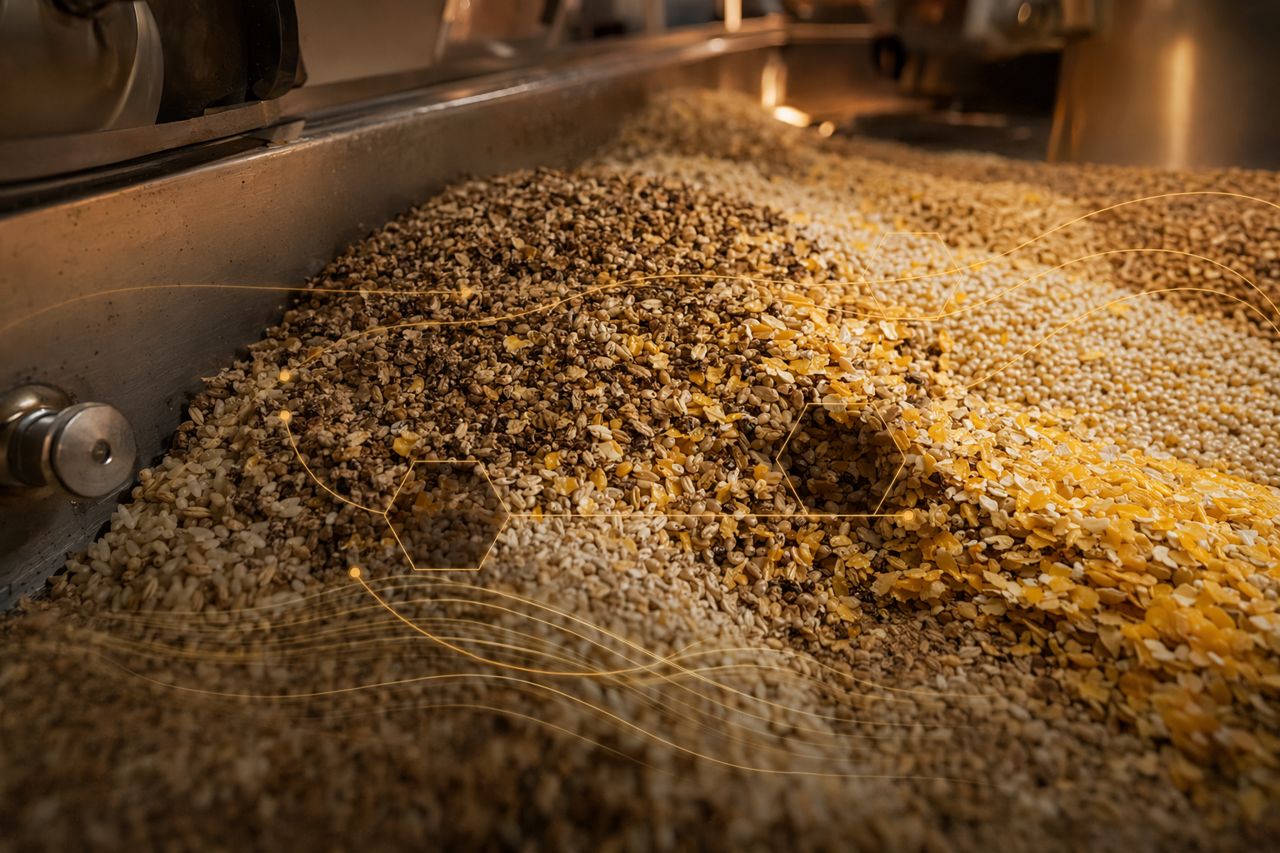
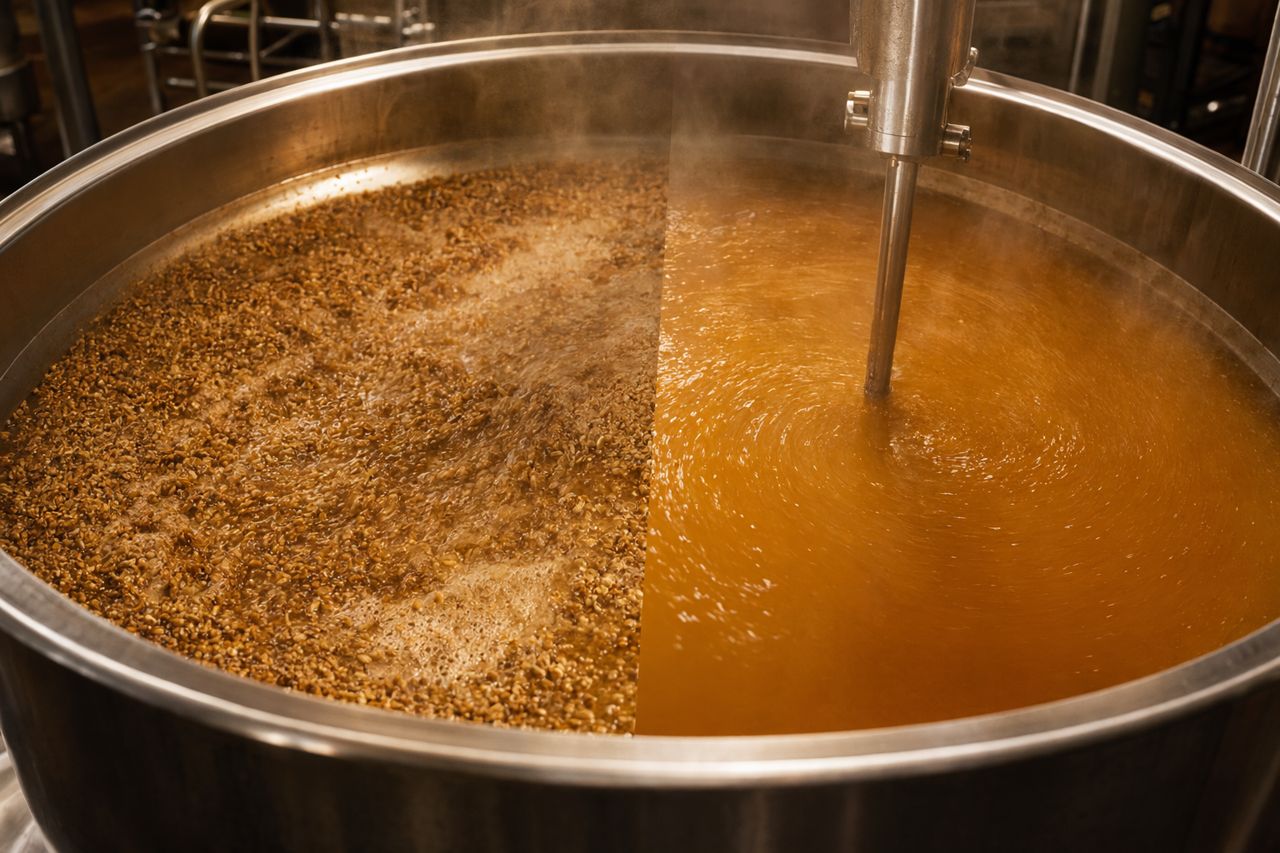
A brewery that had trialled low-carbohydrate beers settled on roughly 25-30% rice with the rest pilsner malt, started around 1.048 and finished below 1.000 at 6.5-7% ABV, with glucoamylase doing the drying. A distiller with a brewing background ran 12 gallon corn batches through a fine grind, an hour of boil with heat-stable liquid amylase, a 155F rest with rye and barley malt and a chill to 80F, and still could not move the mash. Both are high-adjunct problems, and both come down to the same three decisions: which enzyme job the grist needs, what temperature that enzyme will actually see, and how the result is measured before the recipe is scaled. This page is for the production brewer running a fifth to two-fifths of the grist as corn, rice, oats or rye, and for the distributor supplying that brewery, who need those decisions settled before the enzyme is bought in bulk.
Wholesale and bulk supply for breweries and resellers. Send your grist sheet, the quantity you expect to buy and the destination through the inquiry form, and we send back a one-batch trial plan with the dose window to test and a quote.
Three enzyme jobs, and the temperature each one sees
Malt carries its own enzymes; corn, rice and flour carry starch and nothing to break it down, so a thick cereal mash does not fix itself with more rest time. Starch processing in industry is a two-step job: liquefaction with a thermostable alpha-amylase at 105-110 C, then saccharification with glucoamylase near 60 C. That liquefaction figure is a jet-cooking temperature from starch plants, not a brewhouse instruction; a craft cereal cooker runs at the boil, so the point to take from it is the order of the jobs and the gap between their temperatures, not the number itself. In a brewhouse the split looks like this: a standard alpha-amylase is placed in the 149-162 F (65-72 C) mash range, and a thermostable grade is the one that survives the cereal cook with the corn or rice.
Glucoamylase is the saccharification tool when the adjunct starch must go all the way to fermentable sugar instead of being left as dextrin; it keeps cutting dextrins to glucose, which is why it is the enzyme behind brut and ultra-dry rice lagers. Beta-glucanase and xylanase do the third job, viscosity: they thin the gums from oats, rye and wheat so the bed runs off, and they do nothing for starch conversion. Rye, oats, wheat and corn, flaked or unmalted, are non-malt sugar sources for the wort that bring their own flavour and texture, and each one brings its own version of these three problems.
Brewers who buy glucoamylase from us pair it with alpha-amylase more than with anything else, and the common brewery picks are a high-temperature alpha-amylase powder at 100,000 U/g and a liquid beta-glucanase at 13,000 U/g. A thermostable alpha-amylase is also sold as a brewing grade at 40,000 U/g, so the activity on a quote can differ by more than double between two products that both say thermostable; the dose follows the activity, not the word on the bag.
Grist, problem, enzyme, timing, measurement
| Grist | What goes wrong | Enzyme job (named) | When it goes in | What to measure |
|---|---|---|---|---|
| Corn grits, cooked separately | Mash still chunky after an hour of boil with heat-stable amylase, a 155F rest with the malt and a chill to 80F | Thermostable alpha-amylase in the cook; the malt's own enzymes or a mash-range alpha-amylase at the rest | Enzyme into the cooker before the malt; stir through the cook | Does it pump; iodine before the malt goes in |
| Corn flour, 100% corn | Flour balls up and sets like paste | Thermostable alpha-amylase with constant stirring; no malt until it is liquefied | During the cook | Flow, then iodine |
| 100% corn, enzyme-only mash | Temperature points, the starch test and the pH check get skipped | Thermostable alpha-amylase, then glucoamylase | Each at its own temperature point | Starch test and pH at each step |
| Rice, raw | Low efficiency when the rice is not milled and cooked properly | Cereal mash to gelatinise, then conversion in the malt mash | Cooked rice into the main mash | Kettle gravity |
| Flaked rice, about a third of the grist | Nothing, if the enzyme goes in the mash: 1 kg flaked rice with roughly twice that in lager malt, liquid glucoamylase split between mash and fermenter, 62 C for 60 min, mash-out 75 C for 10 min, 15 min boil | Glucoamylase in the mash | Mash | FG 0.998 from OG 1.041, 90% efficiency claimed |
| Rice-heavy bed, light lager | Stuck mash | Rice hulls first, about 10% of the grain bill; a viscosity enzyme is not the fix for a rice bed | Hulls at mash-in | Runoff rate |
| 100% oats, hazy IPA at 7% | Porridge risk; the bed can set | Beta-glucanase (bottled enzymes at mash-in) | Mash-in | Runoff; OG |
| Rye-heavy | Sticky bed without hulls: good beer, hated brew day | Hulls, then beta-glucanase or xylanase | Mash-in | Lauter time |
| Wheat, 50/50 with two-row | Slow or stuck sparge | Hulls worked; oat husks every brew with no problems; beta-glucanase if runoff stays slow after hulls | Mash-in | Sparge time; a stirred bed restarted and landed at 1.052 against 1.053 |
| Malt-only baseline | None; brew it to compare | No addition: a single-infusion mash of one hour, mash-out 75 C for 10 min, 75% efficiency | Standard | OG 1.071, FG 1.015 |
| Any starch adjunct, industrial reference | Thick mash, slow conversion | Thermostable alpha-amylase liquefaction at 105-110 C in a jet cooker, glucoamylase saccharification near 60 C | Two steps, two temperatures | Iodine and gravity |
A brewery that runs oats and other alternative grains at scale does it on a mash filter, which is the equipment answer to the same viscosity problem; milling and step mashes are the process answer.
Selection and troubleshooting, in the order to try it
- Mill gap before enzyme. Crush fine but leave the hulls largely intact as the filter bed; one brewer's shop mill at 0.043 in left the wort 8 points low, and 0.032 in brought him within 2 points of target. Flour has no hulls, so flour needs a cook, not a mill setting.
- Hulls before viscosity enzyme. About 10% of the grain bill as rice hulls is the fix for a rice-heavy stuck mash. Rice hulls absorb wort, so allow for the volume. A commercial brewer's standing rule is to keep rice hulls on hand at all times, and when the bed locks anyway the fix is to clear the blockage and send the mash back to the kettle.
- Cook the cereal before you mash it. Rice for a lager is milled and cooked before it enters the mash, or the efficiency is not there. A cereal mash is what gelatinises raw rice ahead of the main mash. For corn, the cook is where the thermostable alpha-amylase goes, with the temperature points, a starch test and a pH check at each step.
- Pick the grade for the temperature it will see. A standard alpha-amylase works in the 149-162 F mash range; the thermostable grade is for the cereal cook, and the mash-range grade does not belong in the boil.
- Buy by activity, not by teaspoon. Ask for the activity rating and the dose that goes with it, because alpha-amylase covers bacterial liquefaction enzymes and fungal ones that behave differently, and adjunct grists respond differently with gelatinisation, mash schedule and the malt's diastatic power. An Australian brewer could not work out which local enzyme matched a branded viscosity product because the chemical name was never given; insist on the enzyme name (beta-glucanase, xylanase, glucoamylase) on the quote.
- Measure conversion instead of trusting the clock. Mash until an iodine test or the hydrometer says conversion is done; some mashes finish in 40 minutes and the default hour is a habit.
- Sparge slowly. Keep the flow just above a trickle; a 5 gallon batch takes 30-50 minutes to sparge, about 6 gallons of wort.
- If the bed locks. Stop, stir the bed and restart; one brewer who did that landed at 1.052 against a 1.053 target. Raising the temperature helps, since viscosity falls as the mash gets hotter.
- Dry finish: dose the mash, not the fermenter, unless you can pasteurise. Add the glucoamylase about 20 minutes into the mash and rest 60 minutes, and the fermenter addition becomes unnecessary; the boil then denatures the enzyme and the yeast can be reused.
What people get wrong
- Treating the fermenter dose as a dial. A brewer asked whether half the recommended glucoamylase would take a hazy wort from about 1.017 to just a little drier, not a 1.002 brut; the answer was that amylase in any amount keeps working, so the result is overcarbonation at best and bottle bombs at worst. The safer route offered was a quarter of the recommended amount, a gravity sample a few days later, and more only if needed, and even then the beer is kegged cold or pasteurised: "it will continue to slowly ferment unless it gets pasteurized".
- Using the recipe's FG for an enzyme-dried beer. A brewer planned a rice lager at OG 1.045 with FG 1.012 and 15 ml of enzyme in primary, not realising the product was glucoamylase; the replies put the real finish at 1.000-1.003 and warned "if your hydrometer sinks don't panic".
- Assuming a bag marked amylase is glucoamylase. The same brewer admitted he thought all enzymes did the same thing; the product name hid that it was amyloglucosidase. In another thread a commenter pointed out that the enzyme sold in most homebrew shops is a different product from the glucoamylase in the recipe.
- Stacking enzymes without a control. A first brut attempt split a 15 gallon batch three ways and put 20 g of powdered glucoamylase, 5 ml of liquid glucoamylase and a spoon of alpha-amylase into one step mash of 142F for 30 minutes then 152F for 30 minutes. It finished at 1.002-1.003 with no fermenter addition, which is the useful finding; the brewer himself called it a shotgun approach and could not say which enzyme did the work.
- Milling corn to flour and expecting a mash. Ultra-fine corn flour behaves like paste; it is a cook with constant stirring, not a mash. The chunky 12 gallon corn batch above had the same root: no real liquefaction step before the malt went in.
- Expecting one adjunct to behave like another. Against an all-malt control, 10% flaked corn gave a softer, rounder malt flavour and 10% flaked rice gave almost no aroma and let the hops show; both were visibly lighter in colour. A viewer reported 30% corn and rice combined in an American lager, so the grist share decides how much starch the enzymes must handle.
Dosing: two home examples, then the brewery plan
Two home-scale points show the range. In the mash: a liquid glucoamylase split half into the mash and half into the fermenter, over 1 kg of flaked rice as roughly a third of the grist, mashed at 62 C for 60 minutes, took the beer from 1.041 to 0.998; the experienced reply was that the mash half, added 20 minutes in with a 60 minute rest, does the job on its own. In the fermenter: about 1 ml of a liquid glucoamylase at the end of primary dries a batch out entirely, to 1.000-1.003.
Those are vial-and-teaspoon numbers; the home figure buyers are handed is a 1 lb bag at about 1 tsp per 5 gallons, said to cover roughly 480 gallons. Hobby packs run from 1 oz to 1 lb with no minimum, and the next step up is a 25 kg industrial drum, which is the gap a brewery trial has to bridge. For a 5-20 bbl brewhouse a 1 lb pack is enough to run a meaningful trial, and at 50 bbl and up it is worth asking a brewing enzyme supplier for a commercial sample before buying bulk. A brewery dose is written per kg of adjunct at a stated activity, with the cereal-cook and mash additions timed separately; that number depends on your grist share, your activity grade and your cook temperature, so it comes in the trial plan we email back, not from a label.
A one-batch pilot before you change the brewhouse
Run the adjunct batch next to a malt-only baseline: a single-infusion mash of one hour, mash-out at 75 C for 10 minutes, 75% efficiency, OG 1.071 and FG 1.015 is what a clean malt grist gave on a 20 L system. Then brew the adjunct version with the cereal cooked and liquefied first, iodine-check before the malt rest, and record runoff time, kettle gravity and final gravity against the baseline. Decide the finishing enzyme at the same time: mash addition if you reuse yeast and want the boil to stop the enzyme, fermenter addition only if you can pasteurise or hold the beer cold on draught. If the numbers move the way you want, scale the dose per kg of adjunct, not the teaspoon.
What to send for a trial plan and a sample quote
Email us your grist sheet for a one-batch trial plan and a sample quote. Include the adjunct and its form (flake, grit, flour, cooked rice), its share of the grist, the mash schedule with temperatures, the brewhouse size, and the one problem you want solved: conversion, runoff, extract or attenuation. You get back the enzyme order for your grist, the dose window to test per kg of adjunct at the activity we quote, the iodine and gravity checkpoints, and a sample quote. Ask any supplier the same four things: the enzyme's chemical name, the activity grade and how it was measured, powder or liquid, and the pack size that fits your batch count.